Home / Buying guides / Pro audio
Pro audio
Best wireless microphone systems in the UK
By the buychecked team · Updated 9 October 2026 · Prices refresh daily from the retailer feed
For most UK buyers, the safest choice is a UHF system working in the licence-free 863-865MHz band, often called channel 70. It needs no paperwork, gives better range and fewer dropouts than older VHF sets, and is supported by almost every budget and mid-range system. The decisions that matter after that are what type of microphone you need (handheld for singers and hosts, headset or lavalier for presenters and instructors) and how many you need to run at the same time.
Our best overall pick is the Citronic Dual UHF Handheld System, a tunable two-mic set with a rack-mountable receiver. The QTX Dual UHF Handheld System is the best budget option, the Chord Quad UHF Handheld set covers groups that need four mics at once, and the Q-Audio UHF Headset suits fitness instructors who cannot have a beltpack bouncing around.
Below are seven systems across budget, mid-range and upper mid-range prices, followed by a plain guide to frequency bands, microphone types and how many mics you can realistically run together.
How we chose
We have not used these microphone systems ourselves. We shortlisted them by comparing the published specifications, features, price and the retailer's information across the wireless microphone range we list, looking at frequency band, number and type of transmitters, receiver format and outputs, stated range, power and battery arrangements, and how many systems the retailer says can run together. We favoured systems that operate in a licence-free band, and we avoided listing several frequency variants of the same model.
1. Best overall
Dual UHF Handheld Microphone System - Licence Free Band
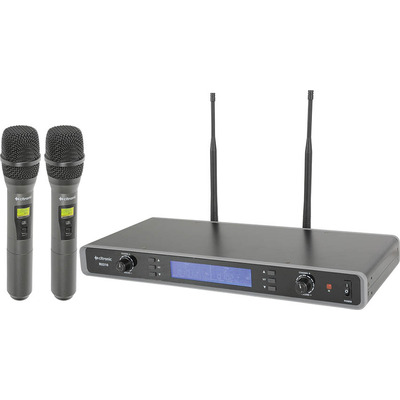
£205.00 at Terralec · best for singers, hosts and small venues needing two mics
The Citronic Dual UHF Handheld System gets the fundamentals right for a two-mic setup. It works in the 863-865MHz band, which the retailer states is licence free in the UK, and it is PLL tunable across 81 frequencies, so you can move away from interference rather than being stuck on one fixed channel. You choose the frequency on the receiver and sync it to each mic by infra-red at the touch of a button. A pilot tone and mute circuit help stop noise when a mic is switched off or out of range, and the stated range is 60m. Rack ears and front antenna mounting are included, and the retailer notes up to two of these systems can run together on the licence-free band, giving four mics in total.
✓ Pros
- Tunable across 81 licence-free frequencies
- Infra-red sync makes setup quick
- Pilot tone and mute circuit for a quieter system
- Rack-mounting kit included
✕ Cons
- Upper mid-range price for two mics
- Handheld only; a separate beltpack version is needed for headsets
- Runs on AA batteries rather than rechargeables
2. Best budget
Dual UHF Handheld Microphone System
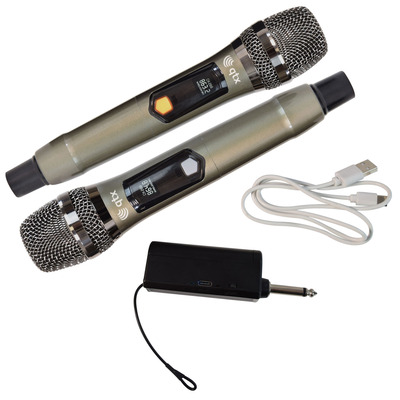
£45.50 at Terralec · best for presentations, karaoke and occasional use
The QTX Dual UHF Handheld System is one of the cheapest ways into UHF wireless. Instead of a separate receiver box, it uses a small plug-in receiver with its own rechargeable battery that pushes straight into a 6.3mm jack input on a mixer, PA speaker or amplifier. The two metal-bodied handheld mics run on AA batteries and operate on two fixed UK/EU licence-free frequencies, with a stated range of up to 50m. The catch is that both mics are mixed to a single output, so you cannot set their levels separately at the mixer, and fixed frequencies leave nowhere to go if something nearby interferes. For a school talk, a party or a two-person presentation those limits rarely matter.
✓ Pros
- Very low price for two UHF mics
- No receiver box or mains lead to deal with
- Licence-free UK/EU frequencies
✕ Cons
- Both mics share one mixed output
- Fixed frequencies cannot be changed to avoid interference
- Single 6.3mm plug output, no XLR
3. Best for groups
Quad UHF Handheld Wireless Mic Systems
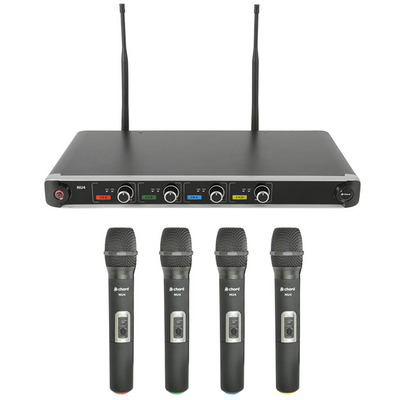
£298.80 at Terralec · best for vocal groups, panels, churches and school productions
If you need four mics live at the same time, a four-channel system in one 1U rack receiver is far tidier than stacking two or more separate sets. The Chord Quad UHF Handheld System supplies four colour-coded handheld transmitters on four fixed licence-free UHF frequencies with pilot tone. The receiver has four balanced XLR outputs, so each mic gets its own mixer channel and EQ, plus a mixed output on a 6.3mm jack for plugging into a simple PA. Batteries and leads are included. The retailer suggests it for vocal groups, theatres and presentations, which matches what a four-mic set is good at. The colour coding is a small but useful touch when four people are grabbing mics off a table.
✓ Pros
- Four mics from one rack receiver
- Individual XLR outputs or a single mixed output
- Colour-coded transmitters are easy to tell apart
✕ Cons
- Fixed frequencies with no tuning options listed
- Using all four licence-free channels leaves little room for other wireless systems nearby
- Handheld only in this version
4. Best handheld and beltpack combo
UHF Dual Channel Wireless Handheld & Beltpack Microphone System
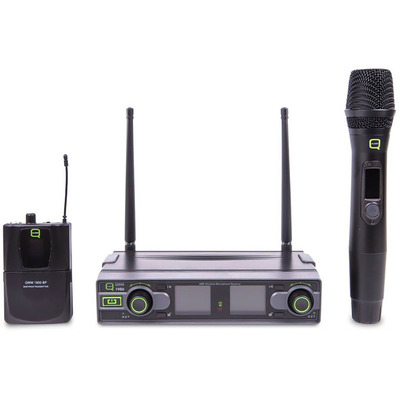
£159.00 at Terralec · best for churches, schools and mixed speaker and singer use
Many churches and schools need one handheld for readings or songs and one hands-free mic for a leader or teacher. The Q-Audio QWM1950HB covers both with one handheld and one beltpack on separate UHF frequencies in channel 70 (863-865MHz). The beltpack works with the supplied tie-clip (lavalier) mic, a headset, or a guitar cable for an electric guitar, which makes it unusually flexible. An auto frequency scan helps find a clear channel, each mic has its own balanced XLR output and volume control, and it comes in a rugged ABS carry case. It sits in the mid-range price band.
✓ Pros
- Handheld and hands-free mic in one set
- Beltpack also works with a guitar
- Auto frequency scan and separate XLR outputs
✕ Cons
- No diversity receiver mentioned in the listing
- Only two mics in total
- Range is not stated in the product information
5. Best for fitness instructors
UHF Wireless Headset Radio Mic by Q-Audio

£109.00 at Terralec · best for aerobics, Zumba and spin classes
A normal headset mic needs a beltpack clipped to your waistband, which is a nuisance during an exercise class. The Q-Audio UHF Wireless Headset has the transmitter built into the headset itself, so there is nothing to clip on or drop. The receiver is very small and plugs straight into a mixer or amplifier input using a 6.3mm jack, which keeps setup simple in a sports hall or studio. It works in the 863-865MHz UHF band with a stated range of up to 30m. The retailer pitches it at aerobics and Zumba instructors, singers and public speakers, but its real advantage is for anyone moving energetically.
✓ Pros
- No beltpack needed at all
- Tiny plug-in receiver
- Licence-free UHF band
✕ Cons
- Single mic only
- Shorter stated range than most systems here
- Battery and power details are not given in the listing
6. Best rechargeable
Twin Handheld UHF Microphone System DM 800H (863.0Mhz-865.0Mhz)

£131.00 at Terralec · best for regular gigs where AA batteries add up
If you use radio mics every week, AA batteries become a real running cost and a real risk when someone forgets to change them. The W Audio DM 800H has metal-bodied rechargeable handheld transmitters with up to 8 hours of battery life, and the receiver has a USB charge output on the rear panel. It operates in channel 70 (863-865MHz), which the retailer states is licence free in the UK, with 90 switchable frequencies, 15 preset groups and IR sync. Each channel has its own balanced XLR output plus an unbalanced mixed output, and intelligent mute silences the receiver if a mic is switched off or goes out of range. It is good value in the lower mid-range band.
✓ Pros
- Rechargeable transmitters with up to 8 hours use
- 90 switchable frequencies and IR sync
- Separate XLR outputs plus a mixed output
- Metal-bodied transmitters
✕ Cons
- Range is not stated in the listing
- Handheld only
- Receiver is fairly large at almost 3kg
7. Best for expanding systems
UHF Dual Channel Diversity Handheld Wireless System - 863-865MHz
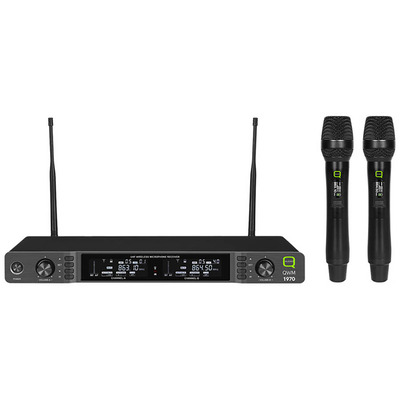
£229.00 at Terralec · best for venues and theatres that may add more mics later
The Q-Audio QWM1970HH is a step up in receiver design. It uses a true diversity receiver, which compares signals from two antennas and switches to the stronger one to reduce dropouts as performers move around. This version runs in the licence-free 863-865MHz band, where up to two systems can be used together. The same system is also sold in a licensed 606-614MHz band version, where the retailer says up to four systems can run together. That makes it a sensible platform for a venue or theatre that might grow to more mics later, because larger multi-mic setups generally need a licensed band. The receiver is 19-inch rack mountable, frequencies are selectable and the handheld transmitters run on two AA batteries each.
✓ Pros
- True diversity receiver for more stable signal
- Licensed-band version available if you expand
- Rack-mountable receiver
✕ Cons
- Upper mid-range price band
- Only two systems together in the licence-free band
- AA batteries rather than rechargeable
UHF vs VHF, and what licence-free means in the UK
VHF systems work at lower frequencies, around 170-175MHz for budget sets. They are cheap but tend to be more prone to interference and dropouts, have fewer usable channels and often use fixed frequencies. UHF systems work at higher frequencies, have more channels to choose from and are generally more reliable, which is why every pick in this guide is UHF.
In the UK, wireless microphones are regulated by Ofcom. The 863-865MHz band, usually called channel 70, can be used without a licence, which is why most budget and mid-range systems use it. The trade-off is that it is narrow and shared, so only a handful of mics can run together reliably. Larger setups often move to a licensed band such as 606-614MHz, commonly known as channel 38, which needs a licence from Ofcom. Check the exact frequency of any system you buy and check current Ofcom guidance if you are unsure whether you need a licence.
Handheld, headset or lavalier?
Handheld mics are best for singers, hosts and anyone passing a mic around. They are robust, easy to share and usually give the best vocal sound. Headset mics sit close to the mouth and stay in place as you move, which makes them the right choice for fitness instructors, teachers walking a classroom and stage performers who need their hands.
Lavalier (lapel or tie-clip) mics are discreet and good for speakers, preachers and presenters, but they pick up more room sound and can be prone to feedback at high volumes because they sit further from the mouth. Headset and lavalier mics both connect to a beltpack transmitter, so a beltpack system often comes with both and lets you choose on the day.
How many mics can you run at once?
Every mic needs its own frequency, and frequencies have to be spaced so they do not interfere with each other. In the licence-free band that limits how many systems you can stack. Several of the retailer listings here say only two dual systems (four mics) should run together, and the quad Chord set uses four channels on its own.
If you need more than four mics, such as for a school musical or a large church, you will usually need a licensed band and a system designed for it. A multi-channel receiver in one rack box is also much easier to manage than several separate receivers, and an antenna distribution system can help when you have many receivers in one rack.
Receivers, outputs and batteries
Plug-in receivers that push straight into a jack socket are the simplest option for a PA speaker, but they often mix all mics to one output. Rack or tabletop receivers with a separate XLR output for each mic let you set the level and EQ of each person on the mixer, which matters for singers and panels.
Look for tunable frequencies, a scan function and pilot tone or mute circuits, which all help a system stay quiet and stable. Finally, think about power. AA batteries are easy to replace but costly over time, and someone has to remember to change them. Rechargeable transmitters save money for weekly users, as long as they go back on charge after each use.
FAQs
Do I need a licence for a wireless microphone in the UK?
Not if it operates in the licence-free 863-865MHz band, often called channel 70, which most budget and mid-range systems use. Systems in other bands, such as 606-614MHz (channel 38), generally need an Ofcom licence. Check the product's exact frequency and current Ofcom guidance.
Is UHF better than VHF?
For most uses, yes. UHF systems usually offer more channels, better resistance to interference and fewer dropouts. VHF sets are cheaper and can be fine for a single mic in a quiet location, but UHF is the safer choice for regular use.
Can I use two wireless mic systems at the same time?
Usually, as long as each mic is on a different, compatible frequency. Many retailers state that up to two dual systems can run together in the licence-free band. Buying a single multi-channel system is the easiest way to avoid clashes.
What is a true diversity receiver?
A true diversity receiver has two separate antennas and receiving circuits and switches to whichever has the stronger signal. This reduces dropouts when a performer moves around or the signal is blocked by people or equipment.
Can I plug a wireless mic receiver into a powered speaker?
Yes, if the speaker has a microphone or line input that matches the receiver's output. Plug-in receivers with a 6.3mm jack are designed for this. Receivers with XLR outputs connect to most PA speakers and mixers with a standard XLR cable.
How far can wireless microphones reach?
Retailers commonly quote 30m to 60m for the systems in this guide. Real range depends on walls, crowds and other wireless equipment, so keep the receiver in line of sight of the performers where possible.
Want to see everything? Browse all pro audio or read our other buying guides.
Affiliate disclosure: buychecked may earn commission from qualifying purchases made via links on this page — at no extra cost to you. Prices checked against live merchant feeds.