Home / Buying guides / Racket sports
Tennis
Best tennis rackets for beginners and club players in the UK
By the buychecked team · Updated 9 October 2026 · Prices refresh daily from the retailer feed
For most adults starting out or playing social and club tennis, the best racket is one that makes clean contact easy and does not punish your arm. In practice that means a mid-plus or oversize head (roughly 100 to 107 sq in), a weight somewhere between about 260g and 300g, and an open 16x19 string pattern. Heavy, small-headed frames used by tour players are harder to swing well and rarely help a developing game.
Our top pick is the Babolat Evo Drive Gen2, a comfort-focused 102 sq in racket aimed at recreational and intermediate players. The Wilson Federer Tour 105 is the best budget choice, the Babolat Boost Drive suits complete beginners who want easy power, and the Head IG Challenge MP is a good step up for regular club players.
Below are seven adult rackets across budget, mid-range and premium price bands, followed by a plain guide to head size, weight, balance and string pattern so you can judge any racket on the shelf.
How we chose
We have not played with these rackets. We shortlisted them by comparing the published specifications, features, price and retailer information across the adult tennis rackets we list, focusing on head size, stated weight, balance, string pattern and the level of player each frame is designed for. We left out junior rackets and frames built mainly for advanced players, and kept to one version of each model rather than listing colour variants separately.
1. Best budget
Wilson Federer Tour 105 Tennis Racket
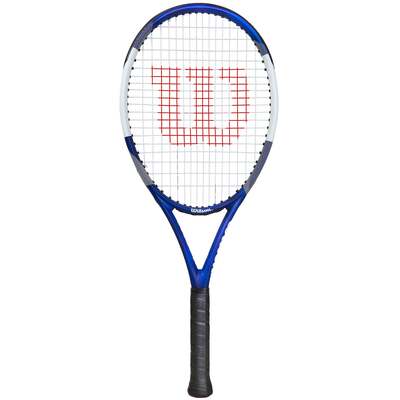
£49.00 at Sweatband · best for new players who want a reliable first racket
The Wilson Federer Tour 105 is one of the cheapest adult rackets in our range and is pitched at beginner to intermediate players. A 105 sq in head gives a large hitting area, and the listing describes a thick 26mm beam, which adds stiffness and free power for shorter swings. At 278g strung with a head light balance it should be easy to move around, and it comes pre-strung with a 16x19 pattern. Wilson lists BLX in the frame for vibration damping. For lessons, park courts and casual doubles it covers what most new players need.
✓ Pros
- Budget price from a major tennis brand
- Large 105 sq in head and pre-strung
- Head light balance keeps it easy to handle
✕ Cons
- Thick, powerful frame can feel hard to control as your swing speeds up
- Factory string is basic; a restring later will improve feel
2. Best for beginners
Babolat Boost Drive Tennis Racket
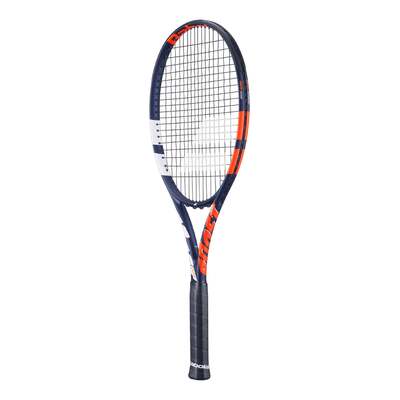
£74.99 at Sweatband · best for adults picking up a racket for the first time
The Babolat Boost Drive is aimed squarely at people new to the game. At 260g it is light, and the head heavy balance puts some of that weight towards the tip so the racket still carries momentum into the ball. That combination gives easy power on short, compact swings, which is what most beginners have. The 105 sq in head adds forgiveness, the 16x19 pattern helps with spin, and Babolat lists its Woofer System for comfort and control. It sits in the budget to mid-range price band.
✓ Pros
- Light 260g frame is easy to swing
- Head heavy balance adds power without a big swing
- Large head and open string pattern
✕ Cons
- Light rackets transmit more shock from hard-hit balls
- Likely to be outgrown once your strokes lengthen
3. Best premium
Wilson Clash 100L V3 Tennis Racket
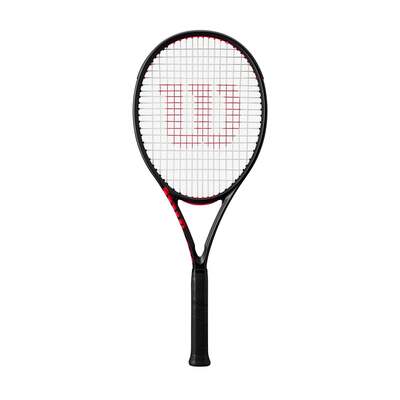
£134.99 at Sweatband · best for intermediates who want a flexible, arm-friendly frame
The Wilson Clash 100L V3 is the most expensive racket here and is aimed at intermediate players who want controllable power with a soft, comfortable feel. Wilson lists FORTYFIVE° technology for a softer feel and stability, SI3D for how the frame bends, and Parallel Drilling for a bigger sweet spot. At 280g it is light enough to handle quickly, and it comes pre-strung with synthetic gut in a 16x19 pattern. If you have had any elbow or shoulder trouble and play often enough to justify a premium price, this is the one to look at first.
✓ Pros
- Comfort-focused frame design
- Light 280g weight for quick handling
- Spin-friendly 16x19 pattern
✕ Cons
- Premium price band
- Listing does not state balance or head size, so check before buying
Head size: how big should you go?
Head size is measured in square inches. Around 95 to 98 sq in is considered midsize and is mostly used by advanced players who want precision. Around 100 to 104 sq in is mid-plus, the most common choice for club players. Anything from about 105 sq in upwards is oversize.
A bigger head gives a larger sweet spot and more trampoline effect from the strings, so you get more power and fewer mishits. The trade-off is control: as your swing gets faster, an oversize frame can send balls long. Beginners and players with short strokes usually do best at 105 sq in or above, while regular club players often settle on 100 to 102 sq in.
Weight and balance
Adult rackets typically range from about 255g to over 300g unstrung. Lighter rackets are easier to swing and manoeuvre, which helps beginners and players who tire quickly. Heavier rackets are more stable at impact, absorb more shock and hit through the ball better, but need more strength and a fuller swing.
Balance tells you where that weight sits. Head heavy rackets carry momentum into the ball, which adds power to light frames, so you often see light rackets paired with a head heavy balance. Head light rackets feel quicker at the net and are common on heavier frames. As a rough rule, beginners suit light and head heavy, while developing club players often move towards a slightly heavier, head light frame.
Retailers sometimes quote strung weight and sometimes unstrung weight. Strings add roughly 15g to 20g, so compare like with like.
String pattern: 16x19, 18x20 and others
The string pattern is the number of main (vertical) strings by cross (horizontal) strings. An open pattern such as 16x19 leaves more space between strings, so they move and snap back more, giving extra spin and a bit more power. Most recreational rackets use 16x19 for that reason.
Denser patterns such as 18x20 give a more controlled, predictable response and make strings last longer, but generate less spin and are usually found on advanced frames. Less common patterns like 18x16 or 16x18 push further towards spin. If you break strings often, a denser pattern or a more durable string will save money.
Grip size and strings
Adult grips in the UK are usually sized from L1 to L4 (sometimes shown as 1 to 4). A rough check is to hold the racket in a forehand grip and see if you can fit the index finger of your other hand between your fingertips and palm. If unsure, go smaller: you can build up a grip with an overgrip, but you cannot make one thinner.
Most rackets at this level come pre-strung with a durable synthetic string. It is fine to start with, but a restring at a sensible tension after a few months of regular play will usually improve feel and comfort.
How much should you spend?
A budget racket from an established brand is perfectly adequate for lessons and casual play. Mid-range rackets bring better materials, more comfort technology and specs better suited to longer swings, and are worth it once you are playing weekly.
Premium frames are not automatically better for you. Many are heavier, stiffer and smaller-headed, built for players who supply their own power. Get the head size, weight and balance right for your level first, then spend more on comfort and refinement if you play often.
FAQs
What tennis racket should a beginner buy?
Look for a head of around 105 sq in or larger, a weight of roughly 255g to 280g and an open 16x19 string pattern. A light, head heavy frame makes it easier to get the ball over the net without a big swing. A budget or mid-range racket from a known brand is enough to start with.
What weight tennis racket is best for an adult?
Most adult recreational players use rackets between about 260g and 300g. Beginners and players with less upper body strength generally suit the lighter end, while regular club players with full swings often prefer 285g to 300g for stability.
Is a bigger head size better?
A bigger head is more forgiving and gives more power, which helps beginners. It is not better for everyone: players with fast swings often find oversize heads hard to control and move to a 98 to 102 sq in frame.
What does 16x19 mean on a tennis racket?
It is the string pattern: 16 main strings running vertically and 19 cross strings running horizontally. It is an open pattern that helps spin and power, and is the most common choice on recreational and club rackets.
How do I know my tennis grip size?
Hold the racket in a normal forehand grip. If the index finger of your other hand fits snugly in the gap between your fingertips and palm, the size is about right. Most adult women use L1 or L2 and most adult men use L2 or L3, but hand size varies.
Which rackets help with tennis elbow?
Look for a frame described as flexible or arm-friendly, with a medium weight, a head light balance and comfort technology in the handle or frame. Softer strings strung at a lower tension also help. Very light, stiff, head heavy rackets tend to pass more shock to the arm.
Want to see everything? Browse all racket sports or read our other buying guides.
Affiliate disclosure: buychecked may earn commission from qualifying purchases made via links on this page — at no extra cost to you. Prices checked against live merchant feeds.