Home / Buying guides / Racket sports
Table tennis
Best table tennis bats for home, club and outdoor play in the UK
By the buychecked team · Updated 9 October 2026 · Prices refresh daily from the retailer feed
A pre-made table tennis bat is the right choice for most people: it arrives ready to play, costs far less than a custom blade with separate rubbers, and the better ones are perfectly good for club sessions. The things that actually change how a bat plays are the blade, the rubber, the thickness of the sponge under it and the shape of the handle. More sponge and a stiffer blade mean more speed; thinner sponge and an all-wood blade mean more control.
Our top pick for most players is the Cornilleau Perform 500, a 5-ply bat with a 1.8mm sponge that sits neatly between control and speed. The Butterfly Timo Boll SG11 is the best budget bat for beginners, the Butterfly Timo Boll SG77 is the one to choose for spin, and the Cornilleau Nexeo X90 Carbon is the pick for garden and outdoor tables.
Below are seven bats across budget, mid-range and premium price bands, followed by a plain guide to blades, rubbers, sponge and handles so you can make sense of any bat listing.
How we chose
We have not played with these bats. We shortlisted them by comparing the published specifications, features, price and retailer information across the table tennis bats we list, looking at blade construction, rubber, stated sponge thickness, handle shape, whether the bat is designed for indoor or outdoor use and the level of player it is aimed at. The product data does not include standardised speed, spin and control ratings, so we have not quoted any; where we describe a bat as faster or more controlled, it is based on its stated sponge, blade and materials. Bats only: we left out tables, balls, nets and covers.
1. Best overall
Cornilleau Perform 500 Table Tennis Bat
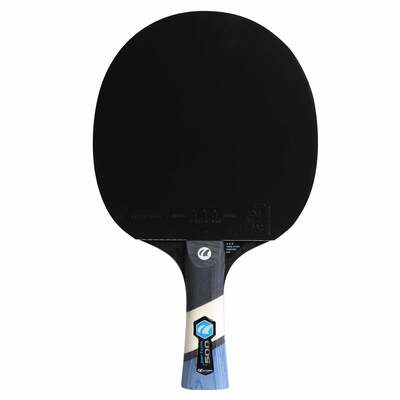
£22.95 at Sweatband · best for regular players who want to improve
The Cornilleau Perform 500 is aimed at regular players who want to build skill, precision and control, and its specification reflects that. A 5-ply wooden blade with a 1.8mm sponge is a middle-of-the-road setup: thick enough to give real pace and spin once your strokes develop, but not so fast that the ball flies long while you are learning. Cornilleau lists its Aero Soft technology for responsiveness and shock absorption, and a concave handle for a secure, comfortable hold. The retailer states it is ITTF approved. It sits in the budget price band, which makes it a sensible first proper bat or an upgrade from a set bat.
✓ Pros
- Balanced 1.8mm sponge suits learning and improving
- Concave handle is the most common club grip
- Budget price for a bat aimed at regular play
✕ Cons
- 3-star rubber offers less spin than higher-grade pre-made bats
- Not designed for outdoor use
2. Best budget
Butterfly Timo Boll SG11 Table Tennis Bat
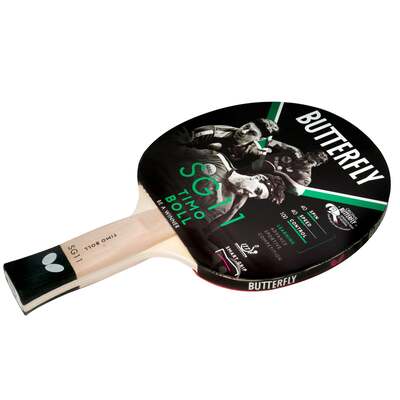
£19.99 at Sweatband · best for beginners and casual home players
The Butterfly Timo Boll SG11 is the cheapest bat on this list and is built around control. Its 1.5mm sponge is on the thin side, which slows the ball down and makes it easier to keep rallies going while you are learning to brush the ball for spin. It uses a 5-ply blade and an ITTF-approved Butterfly rubber, with Butterfly's Smart Grip and protective edge tape. The anatomic handle has a slight bulge in the middle to fill the palm. The retailer describes it as suiting developing players who want to build speed and spin gradually, which is a fair summary of what a thin sponge does.
✓ Pros
- Thin sponge makes control easy for beginners
- Edge tape helps protect the blade from knocks
- Well-known brand at a budget price
✕ Cons
- Will feel slow once your strokes develop
- Indoor bat, not built for damp garden use
3. Best budget for attacking play
Stiga 2 Star Tour Table Tennis Bat
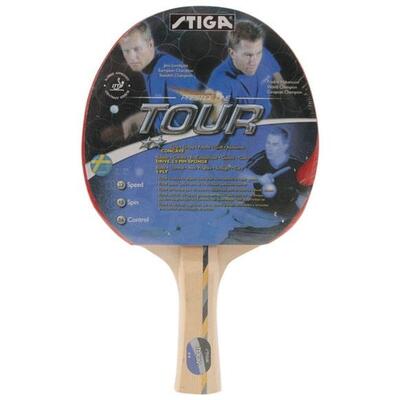
£21.60 at Sweatband · best for beginners who like to hit the ball hard
The Stiga 2 Star Tour is designed with attacking players in mind and leans more towards speed than the Butterfly SG11. Stiga lists a 2mm ITTF-approved rubber on both sides of a 5-ply blade, and the thicker rubber gives more pace on drives and smashes. The rubber is inverted, sometimes called reverse rubber, which is the smooth, grippy surface used by most players for spin. A concave handle completes a conventional club setup. It sits in the budget price band and is a good choice for someone who already plays at home and wants a bat with more punch.
✓ Pros
- Thicker 2mm rubber for more speed
- Inverted rubber suits spin-based strokes
- Budget price
✕ Cons
- Faster bats are harder to control for brand-new players
- Listing gives limited detail on the rubber itself
4. Best for spin
Butterfly Timo Boll SG77 Table Tennis Bat
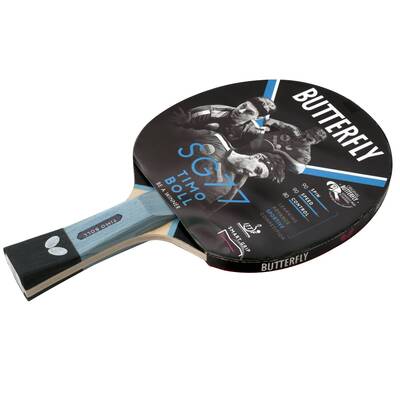
£49.99 at Sweatband · best for intermediate players developing loops and serves
The Butterfly Timo Boll SG77 is the spin-focused option in this list, with the retailer emphasising spin potential and speed without giving up control. It pairs an ITTF-approved Butterfly Pan Asia rubber with a 1.8mm sponge on a 5-ply blade. That sponge thickness gives more speed and dwell time than the 1.5mm sponge on the cheaper SG11 and SG55 bats, which helps when looping and serving with heavy spin. It also has Smart Grip and protective edge tape. It is aimed at intermediate to advanced players and sits in the mid-range to premium band for pre-made bats.
✓ Pros
- Spin-focused rubber and sponge combination
- 1.8mm sponge adds pace over entry bats
- Edge tape protects the blade
✕ Cons
- Costs more than beginners need to spend
- Pre-made rubbers cannot be swapped as easily as a custom setup
5. Best for advanced players
Cornilleau Perform 800 Table Tennis Bat
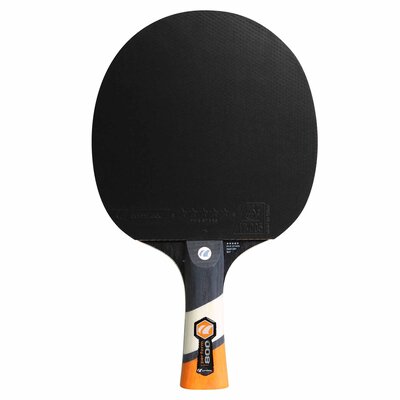
£32.99 at Sweatband · best for experienced club players who want speed
The Cornilleau Perform 800 is the fastest indoor bat on our shortlist on paper. It combines the thickest sponge here at 2mm with a 5-star rubber, and Cornilleau adds carbon to the 5-ply blade for extra rigidity. A stiffer blade and thicker sponge together mean more speed and power, which suits players with established technique who attack from further back. Cornilleau also lists its Aero Soft shock absorption and Dynacell technology, plus an aerodynamic concave handle. It is a lot of bat for the money, but its speed makes it a poor first bat.
✓ Pros
- 2mm sponge and carbon blade for maximum pace
- 5-star rubber, a step up from the 3-star rubber on the Perform 500
- Mid-range price for an advanced-level bat
✕ Cons
- Too fast for beginners to control
- Star ratings are brand-specific, not a universal standard
6. Best for outdoor tables
Cornilleau Nexeo X90 Carbon Table Tennis Bat
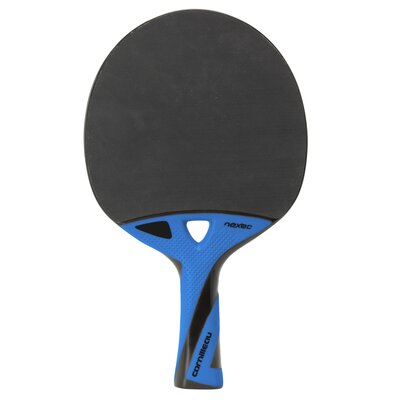
£29.99 at Sweatband · best for garden and patio play
Standard wooden bats with sponge rubbers do not cope well with damp, sun and the odd drop onto a patio, which is where the Cornilleau Nexeo X90 Carbon comes in. Cornilleau lists it as waterproof and shock-resistant, so it is a much better match for an outdoor table that stays in the garden. Carbon in the blade increases rigidity for more power, and the retailer describes it as fast and precise. The handle is ergonomically shaped with a soft-touch grip. It sits in the budget to mid-range band and makes sense for families who play outdoors through the summer.
✓ Pros
- Waterproof and shock-resistant for outdoor use
- Carbon adds stiffness and pace
- Soft-touch ergonomic handle
✕ Cons
- Listing gives no detail on rubber or sponge
- Outdoor-focused build will not feel like a club bat indoors
7. Best premium outdoor
Cornilleau Nexeo X200 Graphite Outdoor Table Tennis Bat
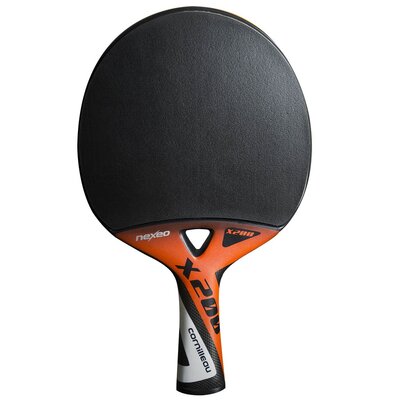
£74.99 at Sweatband · best for keen players with an outdoor table
The Cornilleau Nexeo X200 Graphite is the most expensive bat on our list and is a premium take on the outdoor bat. The retailer describes a one-piece graphite construction that is light, very durable, shock-resistant and weatherproof, and positions it for advanced players wanting speed and precision outdoors. For most garden players the X90 Carbon is enough, but if you play outside often and at a good standard, the X200 is the higher-spec option. It sits in the premium band for pre-made bats.
✓ Pros
- Weatherproof and shock-resistant one-piece build
- Light graphite construction
- Aimed at better players who play outdoors
✕ Cons
- Premium price for an outdoor bat
- Listing gives no detail on rubber, sponge or handle shape
Rubber and sponge: where speed and spin come from
Most bats use inverted rubber, also called reverse rubber: the smooth, grippy side faces out and the pimples face inwards onto a layer of sponge. This is the standard choice because it gives the most spin. Pimples-out rubbers exist but are a specialist choice and rarely fitted to pre-made bats.
Sponge thickness is the single most useful number on a pre-made bat listing. Around 1.5mm is slower and more controlled, which suits beginners. About 1.8mm is a good all-round middle ground. 2mm and above gives more speed and power but is harder to control. If a listing gives one rubber thickness, check whether it means the sponge alone or sponge plus top sheet.
For competitive play under table tennis rules, rubbers need to be approved by the ITTF, the sport's governing body. For home play it does not matter, but an ITTF approval is a useful sign of a properly made rubber.
Blade: plies, wood and carbon
The blade is the wooden part under the rubber. Most pre-made bats use a 5-ply blade, which gives a good balance of feel and speed. Adding carbon or other stiff fibres makes the blade more rigid, which adds speed and power but reduces the feel and dwell time that help with control.
For learning, an all-wood blade with a moderate sponge is easiest. Carbon blades make more sense once your strokes are consistent and you want more pace from further back.
Handle shape: concave, anatomic or straight
Concave, or flared, handles widen towards the end, which helps stop the bat slipping out of your hand on big strokes. They are the most popular choice among club players. Anatomic handles bulge in the middle to fill the palm and feel secure for many people. Straight handles are even all the way down and make it easier to switch grip between forehand and backhand.
If you are not sure, a concave or anatomic handle is a safe default. All of these are shakehand grips; penhold players need a different handle shape.
Star ratings and speed, spin and control numbers
Many pre-made bats carry a star rating or a set of speed, spin and control scores. These are set by each manufacturer rather than any shared standard, so a 3-star bat from one brand is not directly comparable with a 3-star bat from another. They are most useful for comparing bats within the same range, such as Cornilleau's Perform 500 and Perform 800.
Indoor or outdoor bats
Normal bats with wooden blades and sponge rubbers are designed for indoors. Damp, direct sun and temperature swings can warp the blade and age the rubber quickly, so leaving them outside or in a shed is a bad idea.
If you have an outdoor table, a waterproof, shock-resistant outdoor bat such as the Cornilleau Nexeo range is a better choice. It will not play quite like a club bat, but it will survive the conditions far better.
FAQs
What table tennis bat should a beginner buy?
A pre-made bat with an all-wood 5-ply blade, inverted rubber and a sponge of about 1.5mm to 1.8mm is ideal. It is controlled enough to learn on while still letting you add spin. There is no need to start with a carbon blade or a 2mm sponge.
Is a more expensive table tennis bat better?
Only if it suits your level. More expensive pre-made bats tend to be faster, with thicker sponges and stiffer blades, which can make the game harder for beginners. Spend more once your strokes are consistent and you want extra speed or spin.
What does sponge thickness do on a table tennis bat?
Thicker sponge makes the bat faster and more powerful and helps with heavy topspin, but it reduces control. Thinner sponge slows the ball and makes placement easier. Around 1.8mm is a good all-round thickness for most players.
Can I use my normal bat on an outdoor table?
You can for a session, but do not store it outside. Damp and heat can warp a wooden blade and damage the rubber. If you play outside regularly, a waterproof outdoor bat is a better buy.
How long does a table tennis bat last?
On a pre-made bat the rubber wears first, gradually losing grip and spin. Regular players often notice this within a year, while casual home players can use the same bat for much longer. Keeping it in a case and wiping the rubber clean helps it last.
Which handle is best: concave, straight or anatomic?
Concave is the most popular because it is secure on big strokes. Anatomic handles fill the palm, and straight handles make grip changes easier. It mainly comes down to comfort, so choose whichever feels most natural in your hand.
Want to see everything? Browse all racket sports or read our other buying guides.
Affiliate disclosure: buychecked may earn commission from qualifying purchases made via links on this page — at no extra cost to you. Prices checked against live merchant feeds.