Home / Buying guides / Racket sports
Squash
Best squash rackets for beginners, club players and improvers in the UK
By the buychecked team · Updated 9 October 2026 · Prices refresh daily from the retailer feed
The best squash racket for you depends mostly on four things: how much it weighs, where that weight sits, how big the head is and whether the throat is open or closed. A newer player usually benefits from a large head and a forgiving frame that makes clean contact easier. A club player who already has a reliable swing can start choosing between power and precision, and that is where balance and throat shape matter.
Our top pick for most players is the Tecnifibre Carboflex 135 X-Top V2, a large-headed, evenly balanced frame aimed at beginners and intermediates who want to develop an all-round game. The Dunlop Blaze Inferno is the best budget choice for complete beginners, the Karakal Raw 120 is a sensible first graphite racket, and the Tecnifibre Slash 120 suits experienced players who want control above all.
Below are seven rackets across budget, mid-range and premium price bands, followed by a plain guide to weight, balance, head size and throat design so you can judge any racket on the shelf.
How we chose
We have not played with these rackets. We shortlisted them by comparing the published specifications, features, price and retailer information across the squash range we list, looking at stated frame weight, balance, head size, throat design, construction, string pattern and the level of player each racket is aimed at. We left out double packs and junior rackets, and picked one racket per model family so the list covers different needs rather than repeating the same frame at different weights.
1. Best overall
Tecnifibre Carboflex 135 X-Top V2 Squash Racket
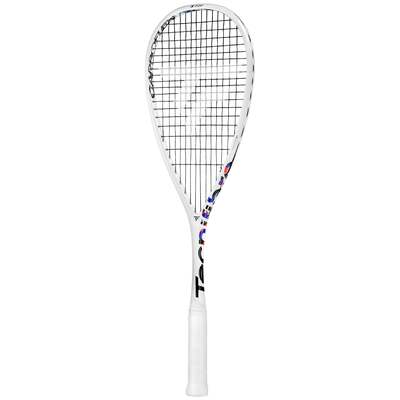
£79.00 at Sweatband · best for beginners and intermediates building an all-round game
The Tecnifibre Carboflex 135 X-Top V2 is the most powerful frame in the Carboflex line and, unusually for that range, the retailer pitches it at beginners and intermediate players rather than experts. An oversized 500cm² head gives a generous hitting area, while the even balance avoids the extremes of a very head-heavy or very head-light racket, which makes it easy to adapt to as your technique changes. In place of a plastic bumper, the top of the head uses shock-resistant aramid fibres with a PTFE treatment for protection. It comes strung with a durable synthetic gut in a 14x18 pattern, which is a sensible, hard-wearing choice for regular club play. It sits in the mid-range price band.
✓ Pros
- Large 500cm² head is forgiving on off-centre hits
- Even balance suits a wide range of playing styles
- From a range used widely at a high level, but aimed at developing players
✕ Cons
- Listing does not state an exact frame weight
- Synthetic gut string feels less lively than a premium multifilament
2. Best budget
Dunlop Blaze Inferno Squash Racket
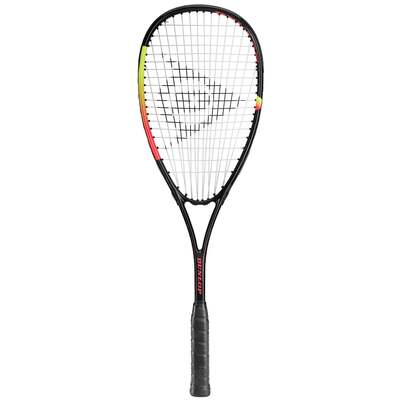
£37.99 at Sweatband · best for complete beginners and occasional players
The Dunlop Blaze Inferno is a straightforward starter racket for people who play now and then or are just taking up the game. Its alloy frame is heavier than a graphite one at a stated 170g, which gives a bit of extra mass behind the ball at slower swing speeds, and the head light balance keeps it from feeling sluggish. The 78in² conventional head and fan-shaped 16x18 Powermax string pattern are designed to enlarge the sweet spot. It is in the budget price band, so expect it to be outgrown once you play weekly and want a lighter, more responsive frame.
✓ Pros
- Budget price from an established squash brand
- Large head and fan string pattern for forgiveness
- Extra frame weight helps slower swings get the ball to the front wall
✕ Cons
- Alloy is heavier and less responsive than graphite
- Regular players will outgrow it quickly
3. Best lightweight for beginners
Head Nano Ti110 Squash Racket
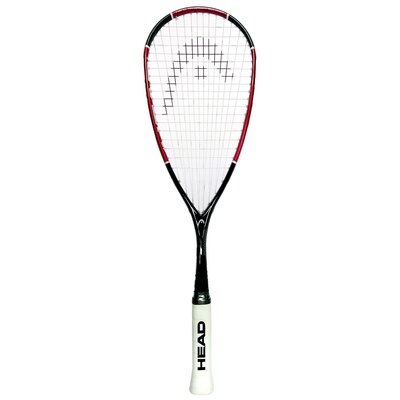
£59.99 at Sweatband · best for new players who want a light racket with built-in power
The Head Nano Ti110 is very light at a stated 110g, but it is head heavy, which puts the mass where it helps you hit through the ball. That combination is well suited to beginners: the frame is easy to move around the court, while the weight in the head and the 500cm² teardrop shape add pace without needing a long, fast swing. Head lists enlarged grommets at 3 and 9 o'clock to widen the sweet spot and a Powerfan string pattern for a forgiving feel, and the racket comes with a full cover. It is in the budget to mid-range price band.
✓ Pros
- Very light frame is easy to manoeuvre
- Head heavy balance and teardrop head add easy power
- Full protective cover included
✕ Cons
- Very light rackets can feel less stable against hard-hit balls
- Power-first design gives less feel on delicate shots
4. Best first graphite racket
Karakal Raw 120 Squash Racket
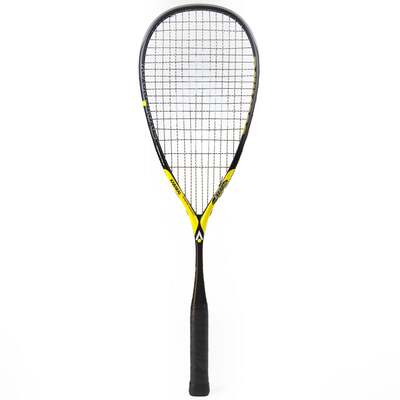
£54.99 at Sweatband · best for recreational players stepping up from an alloy frame
The Karakal Raw 120 is aimed at beginners and recreational players moving up to their first full graphite racket, and that is a worthwhile step. Graphite frames are lighter and more responsive than alloy, and at a stated 120g this one is quick in the hand. The 480cm² head is a little smaller than the oversized frames in this list, which trades a touch of forgiveness for more control. Karakal quotes a 350mm balance point, which on a full-length racket sits slightly towards the head for controllable power. It has an octagonal graphite handle, a PU grip and a full fleece cover, and sits in the budget to mid-range price band.
✓ Pros
- Light graphite frame at a modest price
- Published balance point makes comparison easy
- Fleece cover and grip included
✕ Cons
- Slightly smaller head than oversized beginner rackets
- Synthetic string is durable rather than lively
5. Best value for intermediates
Dunlop Blackstorm Titanium Squash Racket
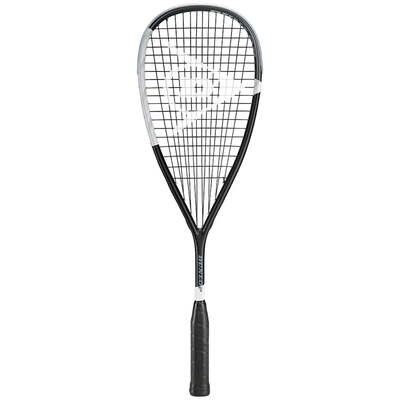
£45.00 at Sweatband · best for club players who like to volley and attack
The Dunlop Blackstorm Titanium is aimed at intermediate players and combines a light 125g frame with a head light balance, so it moves quickly for volleys and short exchanges at the front of the court. The open throat and oversized 500cm² head work together to lengthen the main strings and enlarge the sweet spot, and the 14x18 PowerMax pattern is designed for extra pace. It is strung with Dunlop's X-Life string, which the retailer describes as durable. For a club player who wants a quick, attacking racket without moving into the premium band, it is good value.
✓ Pros
- Light and head light for fast hands at the volley
- Open throat and big head for easy power
- Budget price for an intermediate-level frame
✕ Cons
- Head light rackets need a fuller swing to generate pace from the back
- Less refined feel than premium carbon frames
6. Best for control
Tecnifibre Slash 120 Squash Racket
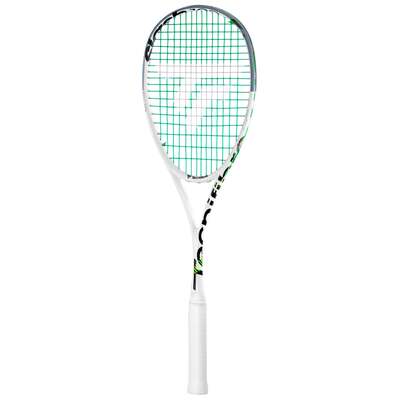
£98.50 at Sweatband · best for advanced players who value precision over raw power
The Tecnifibre Slash 120 takes the opposite approach to most rackets on this list. It has a smaller 461cm² head and a closed throat, which shortens the strings and gives a firmer, more predictable response, and it is evenly balanced at a stated 120g. The retailer describes it as built for flick shots, quick volleys and pinpoint placement, and it is endorsed by Mostafa Asal. It is strung with Tecnifibre 305 in a 14x18 pattern. This is a racket for an experienced player who already generates their own pace and wants to put the ball exactly where they intend. It sits in the upper mid-range to premium band.
✓ Pros
- Closed throat and small head for precise shot-making
- Even balance and light frame for quick handling
- Premium Tecnifibre 305 string fitted
✕ Cons
- Smaller sweet spot punishes mishits
- Not a good choice for beginners
7. Best premium
Dunlop FX 128 Pro Squash Racket
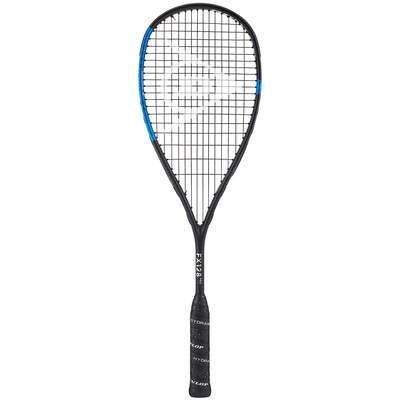
£165.00 at Sweatband · best for advanced attacking players
The Dunlop FX 128 Pro is endorsed by Ali Farag and is designed for advanced, offensive players. At a stated 128g it is light, but the head heavy balance and open throat with an oversized 500cm² head are all aimed at whipping power. It is strung with Iconic Pro AF 1.22 in a 14x19 pattern, and Dunlop's Sonic Core technology is listed for cleaner, more comfortable impacts. This is the most expensive racket on our shortlist, and it only makes sense if you play and train often and have the technique to use a power-oriented frame well.
✓ Pros
- Light frame with head heavy balance for fast, heavy hitting
- Open throat and big head for power
- Thin 1.22 performance string fitted
✕ Cons
- Premium price
- Built for advanced players rather than learners
Frame weight: what the number means
Squash rackets are usually sold by unstrung frame weight, and many models put that weight in the name, so a Dunlop FX 125 is a 125g frame. Strings, grip and bumper add weight on top, so two rackets with the same stated figure can feel different once they are ready to play.
Graphite performance rackets mostly fall between about 110g and 145g. Lighter frames are quicker for volleys and short exchanges and are less tiring over a long session. Heavier frames feel more stable and carry the ball through more easily when your swing is shorter. Alloy beginner rackets are heavier still and less responsive.
Do not choose on weight alone. A light frame with a head heavy balance can hit harder than a heavier frame with a head light balance, so always read the two numbers together.
Balance: head heavy, head light or even
Balance tells you where the weight sits along the racket. A head heavy racket puts more mass at the top, which adds power and stability but makes the racket a little slower to move. A head light racket keeps the weight towards your hand, so it is faster for volleys, drops and quick changes of direction, but you need a fuller swing to create pace.
Evenly balanced rackets sit in the middle and are a good default if you are not sure what you prefer. Some brands publish an exact balance point in millimetres; on a full-length racket, a figure a little above the midpoint means the racket leans slightly towards the head.
Head size and string pattern
Head sizes typically range from around 455cm² to 500cm². A larger head gives a bigger sweet spot and more forgiveness, which helps beginners and anyone who plays only occasionally. A smaller head is more precise and responsive but rewards consistent contact.
String pattern matters too. Open or fan-shaped patterns with fewer strings, such as 12x17, tend to give more power and bite, while denser patterns such as 14x18 or 14x19 feel more controlled and keep strings lasting longer. Some Head rackets let you switch between a straight and a fan pattern when you restring.
Open throat or closed throat
In an open throat racket, often called a teardrop shape, the head flows straight into the shaft with no bridge. The main strings are longer, which enlarges the sweet spot and adds trampoline effect, so open throat rackets are the more forgiving and powerful option for most players.
A closed throat racket has a bridge across the bottom of the head, giving a more traditional shape with shorter strings. The response is firmer and more predictable, which many experienced players prefer for control, feel at the front of the court and accurate length. If you are still learning, an open throat is usually the easier choice.
How much should you spend?
If you are trying squash for the first time or play a few times a year, a budget alloy or entry-level graphite racket is enough. Once you play every week, a mid-range graphite frame is the best value: lighter, more responsive and better strung.
Premium rackets mostly add refined materials, thinner performance strings and pro-endorsed designs. They are worth it for frequent players who know what balance and head size they like, but they are not a shortcut to playing better.
FAQs
What squash racket should a beginner buy?
Look for a large head of around 500cm², an open throat and either a head heavy or even balance. That combination is the most forgiving and helps you get the ball to the front wall with a shorter swing. A budget or lower mid-range racket is plenty; there is no need to start with an advanced, pro-endorsed frame.
What weight squash racket is best?
Most adult players use graphite rackets between about 115g and 135g. Lighter frames suit quick, attacking players and anyone who wants less strain on the arm, while heavier ones feel more stable. Always consider balance alongside weight, as it changes how heavy the racket feels in use.
Is a head heavy or head light squash racket better?
Neither is better overall. Head heavy rackets give more power and stability and suit players with shorter swings. Head light rackets are quicker to manoeuvre and suit players who volley a lot and generate their own pace. An even balance is a safe middle ground.
What is the difference between an open and closed throat squash racket?
An open throat, or teardrop, racket has no bridge between head and shaft, so the strings are longer and the sweet spot bigger, giving more power and forgiveness. A closed throat racket has a bridge, shorter strings and a firmer, more controlled feel that many experienced players prefer.
How often should I restring a squash racket?
A common rule of thumb is to restring as many times a year as you play each week, so twice-weekly players would restring about twice a year. Strings lose tension and liveliness over time even if they do not break, so a restring can make an older racket feel noticeably better.
Want to see everything? Browse all racket sports or read our other buying guides.
Affiliate disclosure: buychecked may earn commission from qualifying purchases made via links on this page — at no extra cost to you. Prices checked against live merchant feeds.