Home / Buying guides / Bras
Maternity
Best nursing and maternity bras in the UK
By the buychecked team · Updated 9 October 2026 · Prices refresh daily from the retailer feed
A good nursing bra does three jobs. It supports a bust that may have grown by a cup size or more, it stretches comfortably as your size changes from day to day, and it lets you unclip a cup with one hand while holding a hungry baby. Most nursing bras do this with a clip on each strap that lets the cup drop down, a soft or flexible cup, and a back fastening with extra rows of hooks.
For most people our pick is the Naturana Maternity non-wired nursing bra: a soft, non-padded, wire-free design with higher sides and back, nursing clips and a hook and eye fastening, at a sensible price and in a wide spread of sizes. If you are in a fuller cup size, the Royce Charlotte nursing bra adds side slings and full-coverage cups without a wire. If you prefer the shape of a wired bra, the Freya Pure moulded nursing bra uses a flexi-wire designed for breastfeeding.
Below are seven options across budget, mid-range and premium prices, then practical advice on when to buy, how sizing changes through pregnancy, and wire-free versus flexi-wire. One honest warning: many listings only have a few sizes left in stock, so check your size is available before you set your heart on a style.
How we chose
We have not tried these bras on. We shortlisted them by comparing the published construction details, features, size availability and price of nursing and maternity bras across the range we list, focusing on what matters while feeding: how the cups open, how the bra supports without pressing on breast tissue, band adjustability and comfort for long wear. We relied on each retailer's product description rather than its filter tags, because several listings are tagged 'padded' when the description says the cups are non-padded. We chose a spread of brands, support types and price points. Stock is often limited to a handful of sizes per colour, so check availability in your size before buying.
1. Best underwired
Panache Ana Maternity Nursing Bra - Vintage

£33.60 at Belle Lingerie · best for fuller busts that want structure and a pretty, plunging look
Panache's Ana is a proper underwired bra adapted for nursing, with drop-down cups, a plunging neckline and a stretch lace top cup that gives a little room as your size changes. The wire sits in a padded casing for comfort, there is an inner cotton side sling, and the lower cups are lined with hidden stabilisers for support. The detail we like most is the six-row hook and eye fastening, which gives much more band adjustment than a standard bra and helps it keep fitting as your ribcage changes during and after pregnancy. It sits in the mid-range. As with any underwired nursing bra, check the wire sits fully on your ribcage and not on breast tissue.
✓ Pros
- Six-row back fastening for changing band size
- Stretch lace top cup allows some fluctuation
- Side sling and stabilised lower cups
- Feminine plunge design
✕ Cons
- Underwire is not ideal in the early weeks
- Limited sizes in stock in this colour
2. Best for nights and lounging
Panache Katherine Nursing Bra - Black

£30.40 at Belle Lingerie · best for sleeping, night feeds and days at home
Many people want a softer bra for night feeds and to hold breast pads in place while sleeping. Panache's Katherine is a non-wired crop top style with drop-down cups for feeding and moulded cups that keep a natural, rounded shape. It has an elastic underband rather than a structured one, and the back fastens with six hooks, so you can loosen or tighten it as your ribcage changes through pregnancy and afterwards. It is mid-range in price, which is more than a basic sleep bra, but it is supportive enough to wear around the house during the day too.
✓ Pros
- Comfortable non-wired crop top design
- Six-row back fastening for adjustability
- Works for night feeds and daytime lounging
✕ Cons
- Lighter support than a full nursing bra
- Limited sizes currently in stock
3. Best budget
Pour Moi Love To Lounge Nursing Bra - Soft Pink
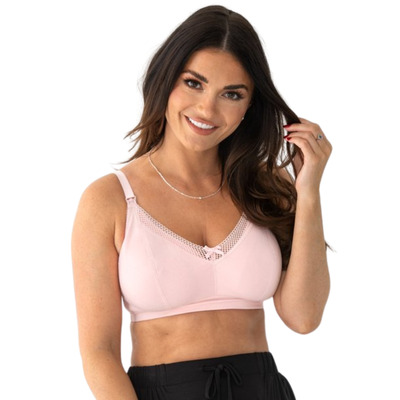
£10.40 at Belle Lingerie · best for a cheap, comfortable spare for the laundry rotation
You will want at least three nursing bras, and the Pour Moi Love To Lounge is a sensible, low-cost way to make up the numbers. Despite the lounge name it is a properly constructed nursing bra: full-cup coverage, wireless and non-padded cups, an inner side sling for extra support, drop-down clips for feeding, adjustable straps and a hook and eye back. A lace neckline keeps it from looking too plain. The retailer's filter tags list it as padded, but the description is clear that the cups are non-padded. It sits at the budget end, though stock is limited, so check your size.
✓ Pros
- Budget price
- Inner side sling for extra support
- Full-cup coverage with drop-down clips
✕ Cons
- Very limited sizes in stock
- Lighter support than the more structured picks
When to buy a maternity or nursing bra
Breasts often change early in pregnancy, and many people find their usual bras uncomfortable by the end of the first trimester. At that point a soft, stretchy maternity bra is usually all you need. The bigger change tends to come later, so a common approach is to buy your nursing bras at around 36 weeks, when your ribcage has expanded and your bust is closer to the size it will be when your milk comes in.
Buy two or three nursing bras to start with: one to wear, one in the wash and one spare. Many people buy one or two before the birth and the rest a few weeks after, once feeding is established and size has settled. Expect your size to change again when your milk comes in, usually a few days after birth, and again as feeding settles into a pattern. Stretch cups and soft fabrics cope with this far better than rigid moulded cups.
Sizing through pregnancy and after birth
Your band size often grows as your ribcage expands to make room for your baby, and your cup size usually increases too. When you buy a nursing bra in late pregnancy, choose one that fits on the tightest hook. That leaves room to loosen it as your ribcage grows, and to move back towards the tighter hooks after birth as your ribcage returns. Bras with five or six rows of hooks, such as the Panache Ana and Katherine, give you more room to adjust. A bra extender is a cheap fix if a band gets tight.
The cups should allow a little room, roughly a cup size, for fullness when your milk comes in, without gaping now. A stretch lace or stretch top cup helps here. If you are between sizes, choose the one that fits comfortably without pressing anywhere, because tight bras can contribute to blocked ducts.
Many of the listings in this category only have a handful of sizes left in each colour, so check your size before you get attached to a style. If your exact size is missing, the sister size (one band down and one cup up, or one band up and one cup down) is sometimes worth trying, but nursing bras need a comfortable fit, so only do this if the fit feels right.
Drop-down clips and other ways to open the cup
Most nursing bras use a clip where the strap meets the top of the cup. Unclip it and the cup folds down, leaving a fabric sling or frame in place to support the breast. Look for a clip you can open and close with one hand, because you will often be holding your baby with the other. Practise a few times before the birth so it feels natural when you are tired.
Some bras use a front clasp at the centre instead. Others are pull-aside or crossover styles, common in sleep bras, where you simply move the fabric aside. Pull-aside styles are easy but can put pressure on the breast if the fabric is tight, so they suit softer, stretchier bras rather than structured ones. A side sling or internal frame, as on the Royce Charlotte and Freya Pure, keeps the bra stable when one cup is open.
Non-wired or flexi-wire?
Wire-free bras are the usual recommendation in pregnancy and in the early weeks of breastfeeding. Breasts change size quickly at this stage, and a rigid wire that sits on breast tissue rather than the ribcage can press on milk ducts. Modern non-wired nursing bras get their support from a firm underband, side slings, seamed or spacer cups and wider straps, and many people with fuller busts wear them full time.
Flexi-wire bras use a softer, bendable wire designed to give more lift and shape while moving with your body. Many people switch to one once feeding is established, often after six weeks or so, especially if they find soft cups unsupportive. The key is fit. The wire should sit flat on your ribcage all the way round the breast, never on breast tissue, and it should not leave marks. If you have had blocked ducts or mastitis, stay with wire-free and follow your midwife's or health visitor's advice.
Fabric, padding and nursing pads
Cotton and cotton-rich fabrics are breathable and gentle, which helps with leaks and sensitive skin. Spacer cups, used by Anita and Freya, are light and breathable but hold a shape, which helps hide nursing pads under fitted tops. Non-padded soft cups adapt better to daily size changes but show pads and nipples more. Some bras have removable foam inserts so you can choose.
Product filter tags for padding are not reliable in this category. Several bras here are tagged 'padded' while the description says the cups are non-padded, so read the description before buying. Wash nursing bras on a cool, gentle cycle in a mesh bag with clips fastened, and dry them flat to keep the band elastic in good condition.
FAQs
When should I buy a nursing bra?
Around 36 weeks of pregnancy is the usual advice, when your ribcage has expanded and your bust is closer to its feeding size. Buy two or three to start with, and expect to buy more or a different size a few weeks after birth once feeding is established.
Can I wear an underwired bra while breastfeeding?
Many people do once feeding is established, but wire-free bras are usually recommended in the early weeks. If you choose a wired or flexi-wire bra, make sure the wire sits on your ribcage and not on breast tissue. Stop wearing it if you notice soreness, lumps or red patches, and speak to your midwife or GP.
What is the difference between a maternity bra and a nursing bra?
A maternity bra is designed for comfort and support during pregnancy, often with soft stretchy cups and extra band adjustment. A nursing bra adds a way to open the cups for feeding, usually drop-down clips on the straps. Many bras, such as the Naturana Maternity nursing bra, are designed for both.
How many nursing bras do I need?
Three is a practical minimum: one to wear, one in the wash and one spare for leaks. Many people also want a soft sleep bra for night feeds. It is often better to buy two before the birth and the rest afterwards, once you know your new size.
What size nursing bra should I buy when pregnant?
Get measured at around 36 weeks if you can. Choose a band that fits on the tightest hook, so you can loosen it as your ribcage grows, and cups that leave roughly a cup size of room for when your milk comes in. Soft, stretchy cups cope best with size changes.
Can I sleep in a nursing bra?
Yes, many people do, especially to hold nursing pads in place during night feeds. Choose a soft, wire-free style with no tight elastic, such as a crop top or sleep bra, and make sure it does not press on your breasts.
Want to see everything? Browse all bras or read our other buying guides.
Affiliate disclosure: buychecked may earn commission from qualifying purchases made via links on this page — at no extra cost to you. Prices checked against live merchant feeds.