Home / Buying guides / Strength
Home strength
Best home weights and dumbbells in the UK
By the buychecked team · Updated 9 October 2026 · Prices refresh daily from the retailer feed
For most people setting up strength training at home, a good pair of adjustable dumbbells is the single most useful thing to buy. One pair replaces a rack of fixed weights, lives in a corner, and covers presses, rows, lunges and curls. Add an adjustable bench and you can train almost every major muscle group without a rack or barbell.
Our top pick is the NordicTrack 25kg Select A Weight set, because it goes up to 25kg per hand in small steps, which matters more than people expect once you start progressing. If budget is tight, the Viavito 20kg cast iron spinlock set is the cheapest sensible way to start. For heavier lifters, the BowFlex SelectTech 1090i set reaches 41kg per dumbbell.
Below we also cover a lighter PowerBlock set for beginners, a vinyl kettlebell set, and two FID benches at different price points, followed by advice on weight ranges, increments, floor space and what to check before you order.
How we chose
We have not tested these products hands-on. We shortlisted them by comparing the published specifications, features, price and retailer information across the strength range we list, looking at weight range per hand, how finely the weight can be adjusted, stated maximum loads for benches, included storage, and how much floor space each option needs. We favoured products whose listings give clear figures, so you can check they suit you before buying.
1. Best overall
NordicTrack 25kg Select A Weight Adjustable Dumbbell Set
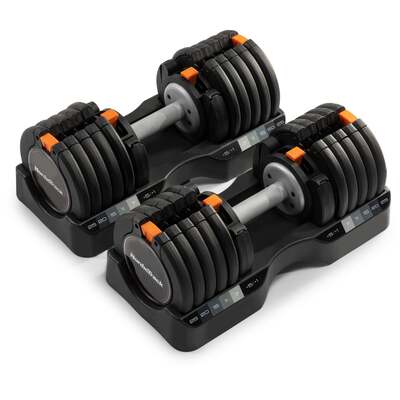
£299.00 at Sweatband · best for most home lifters who want room to progress
The NordicTrack Select A Weight set goes from 5kg to 25kg per dumbbell, and the retailer lists 1kg, 2kg and 5kg increments rather than the fixed 5kg jumps of cheaper twist-handle sets. That finer adjustment is what makes a set last: moving from 10kg to 15kg on a shoulder press is a big leap, while 10kg to 12kg is manageable. The listing says the pair replaces 30 dumbbells, and there is optional iFIT content if you want guided sessions, though a membership is needed for that. Sitting in the mid-range price band, it is the best balance of range, adjustability and cost in this list.
✓ Pros
- Fine weight steps make steady progression easier
- 25kg ceiling suits most home lifters for years
- Replaces a full rack of fixed dumbbells in a small footprint
✕ Cons
- iFIT workouts need a paid membership
- 5kg minimum may be heavy for some isolation work
- Selector-style dumbbells are bulkier than fixed ones at light weights
2. Best budget
Viavito 20kg Black Cast Iron Dumbbell Set
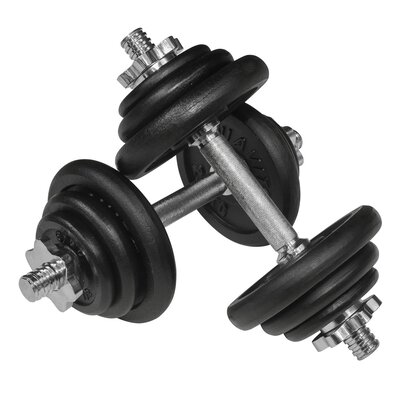
£49.00 at Sweatband · best for beginners on a tight budget
This Viavito set is the traditional approach: two 35cm chrome bars with knurled grips, spinlock collars and 12 cast iron plates that build up to a pair of 10kg dumbbells. Changing weight takes longer than a dial or pin system, but it costs a fraction of the price and the standard 1-inch plates are widely available if you want to add more later. It is a sensible first set for upper-body work and lighter lower-body exercises. Stronger lifters will outgrow 10kg per hand fairly quickly on movements like rows and goblet squats.
✓ Pros
- Budget price for a full pair of dumbbells
- Standard 1-inch plates can be added to over time
- Knurled chrome handles for a secure grip
✕ Cons
- Maximum of 10kg per hand
- Spinlock changes are slower than adjustable systems
3. Best premium
BowFlex SelectTech 1090i Adjustable Dumbbell Set
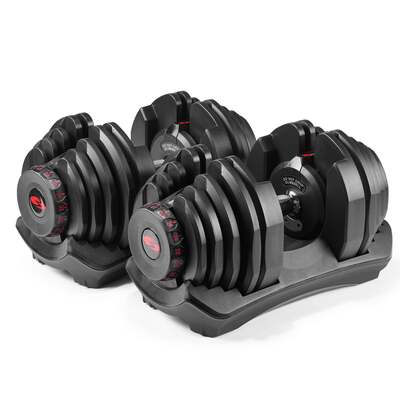
£499.00 at Sweatband · best for stronger lifters who want heavy dumbbells without a rack
The BowFlex SelectTech 1090i set covers 4kg to 41kg per dumbbell across 17 weight options, which is far heavier than the 25kg sets here. That headroom matters for leg and back work, where many people quickly move past 25kg. BowFlex lists a locking mechanism and firm grips, plus a two-month JRNY trial with guided workouts and rep counting. It sits in the premium bracket, and dumbbells this heavy are long and bulky, so check you have space to handle them comfortably on a bench.
✓ Pros
- Very wide range, up to 41kg per hand
- 17 settings give plenty of progression points
- Includes a JRNY app trial for guided sessions
✕ Cons
- Premium price
- Long dumbbells can feel unwieldy for some exercises
- More weight than many beginners will ever need
4. Best for beginners
PowerBlock Sport 24 Adjustable Dumbbells
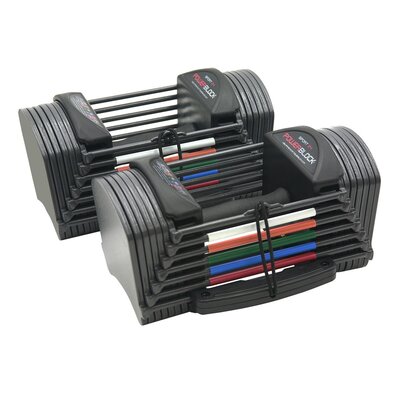
£179.00 at Sweatband · best for lighter training, toning and smaller spaces
The PowerBlock Sport 24 runs from 1.5kg to 11kg per hand and, according to the listing, replaces eight pairs of traditional dumbbells. That lighter range suits newer lifters, rehab-style work, shoulder exercises and circuit training better than a 5kg-minimum set. PowerBlock's block shape is compact, and the handles are tapered with recessed dial locks. Note that the retailer states the Sport 24 cannot be expanded, so if you think you will want heavier weights, the 25kg sets are a better long-term buy.
✓ Pros
- Low starting weight suits beginners and isolation work
- Compact block design
- Supplied as a pair
✕ Cons
- Cannot be expanded beyond 11kg per hand
- Most people will outgrow it for legs and back
5. Best kettlebell set
DKN 2, 4, 6 and 8kg Vinyl Kettlebell Weight Set
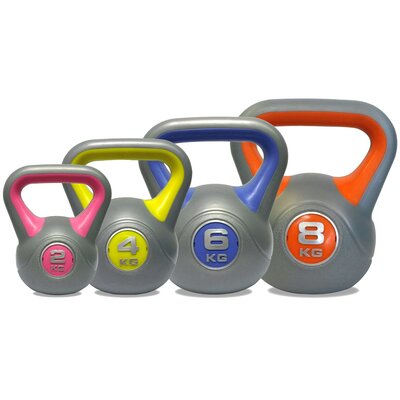
£39.00 at Sweatband · best for swings, circuits and conditioning at home
This DKN set gives you four colour-coded vinyl kettlebells at 2kg, 4kg, 6kg and 8kg, with an anti-slip base and a workout chart in the box. Vinyl coating is kinder to floors than bare iron, and having several weights to hand makes circuits quicker than adjusting a single bell. The range is aimed at toning, mobility and lighter conditioning work. For two-handed swings, most adults will want something heavier, so treat this as a starter set and add a single heavier bell later.
✓ Pros
- Four weights in one budget-friendly set
- Colour-coded and coated for floor protection
- Workout chart included
✕ Cons
- 8kg top weight is light for swings
- Four separate bells take more space than one adjustable kettlebell
6. Best bench
Half Human 3 Way Adjustable FID Utility Bench
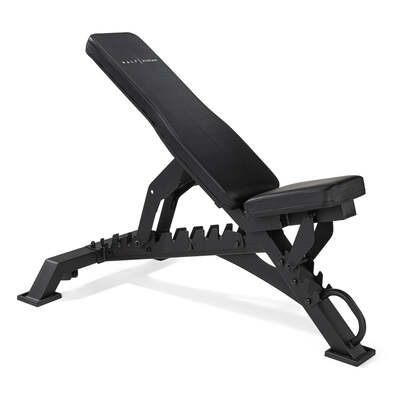
£149.00 at Sweatband · best for pairing with heavier dumbbells
The Half Human 3 Way bench adjusts to flat, incline and decline, with a 10-position backrest and a 4-position seat, so you can set the seat angle to stop sliding on steep inclines. Its listed maximum load is 240kg including the user, the highest of the benches we shortlisted, which gives a useful margin if you are pressing heavy dumbbells. The 60mm padding is a reasonable thickness for a utility bench. It sits in the mid-range and is the bench we would pair with the NordicTrack set or the BowFlex.
✓ Pros
- Flat, incline and decline positions
- 240kg listed maximum load
- Adjustable seat as well as backrest
✕ Cons
- Costs more than basic flat or FID benches
- Adjustable benches take more storage space than flat ones
7. Best budget bench
Viavito TG400 FID Utility Weight Bench
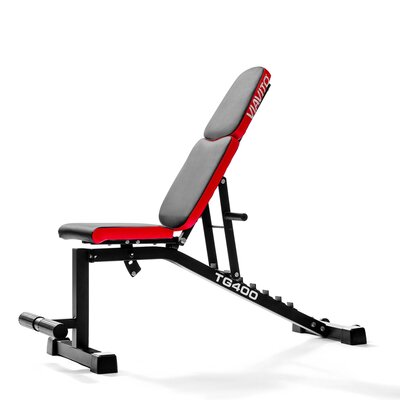
£99.00 at Sweatband · best for a first adjustable bench
The Viavito TG400 offers decline, flat, upright and five incline positions with a 2-position seat, and a stated maximum load of 200kg including the user. That covers chest press, shoulder press, rows and core work, which is all most home routines need. It is cheaper than the Half Human, with fewer seat settings and a lower load limit, but for someone lifting with a 10kg to 25kg pair of dumbbells, that 200kg rating leaves plenty of room. Check the bench's floor footprint and storage before ordering.
✓ Pros
- Full FID adjustment at a budget-to-mid price
- 200kg listed maximum load
- Upright position for seated shoulder work
✕ Cons
- Fewer seat positions than the Half Human
- Lower load limit than our main bench pick
Adjustable or fixed dumbbells?
Fixed dumbbells are simple and quick to grab, but a useful range takes up a lot of room and money. A pair at every 2kg from 4kg to 24kg is eleven pairs, plus a rack. That is why most home lifters choose adjustable dumbbells, where one pair covers the whole range.
There are three main adjustable styles. Spinlock sets (like the Viavito) use plates and threaded collars, which are cheap but slow to change. Dial and twist systems (Half Human's sets use a handle twist, for example) select plates from a tray as you lift the handle out. Pin-select blocks (such as PowerBlock's Pro range) use a selector pin in a compact cage. Dial and pin systems change weight in seconds, which matters if you train in supersets or circuits.
Fixed dumbbells still make sense for one or two weights you use constantly, or if more than one person trains at the same time.
How heavy should you go?
As a rough guide, a beginner can use 2kg to 8kg for shoulder raises and arm work, 6kg to 16kg for presses and rows, and more for goblet squats and lunges. Within a few months, many people want 15kg to 20kg per hand for lower-body and back work.
That is why the maximum weight per hand is the key number. A 10kg or 11kg set is fine for toning and upper-body work but will feel limiting for legs. A 25kg set suits most home lifters long term. Go for 40kg or more only if you are already strong or plan to do heavy rows and presses.
Check whether a listing quotes weight per dumbbell or for the whole set. A "20kg set" usually means 10kg per hand.
Why weight increments matter
Progress in strength training comes from adding small amounts of weight over time. If your dumbbells only move in 5kg steps, the jump from 5kg to 10kg on a lateral raise is a doubling of the load, which most people cannot manage with good form.
Sets with 1kg, 2kg or 2.5kg steps are much easier to progress on, especially for smaller muscles like shoulders and arms. When comparing options, look at the number of settings and the gap between them, not just the top weight.
Choosing a bench
A flat bench is the cheapest option and covers chest press and rows. An FID bench (flat, incline, decline) adds incline pressing and seated shoulder work, which is why it is the most popular home choice. An adjustable seat stops you sliding forward when the backrest is steep.
Look for the stated maximum load and check whether it includes your body weight. Add your weight to the heaviest dumbbells you plan to use and leave a generous margin. Also check the footprint and whether the bench can be stood upright or stored easily.
Space, flooring and noise
Measure where you will train. You need room to lie on a bench with your arms out wide and to lunge forward and back. Around two metres by two metres is a comfortable minimum for dumbbell and bench work.
Put a rubber gym mat down to protect floors, especially upstairs or on laminate. Rubber or vinyl coatings are quieter than bare cast iron, and hex dumbbells will not roll when you set them down. If you live in a flat, place weights down gently rather than dropping them, whatever they are made of.
FAQs
Are adjustable dumbbells worth it?
For most home gyms, yes. One adjustable pair replaces many fixed pairs, saves a lot of floor space and usually costs less than buying the same range of fixed dumbbells. The trade-off is that they are bulkier at light weights and take a few seconds to adjust.
What weight dumbbells should a beginner buy?
A set that starts around 2kg to 5kg and goes up to at least 15kg to 25kg per hand covers most beginners for a long time. If you only want light toning work, a range up to 10kg or 11kg is enough, but you will likely outgrow it for legs and back.
Do I need a bench to train with dumbbells?
No, you can do squats, lunges, rows, deadlifts and standing presses without one. A bench adds chest pressing, incline work and supported rows, so it is the most useful second purchase after dumbbells.
What is an FID bench?
FID stands for flat, incline and decline. It means the backrest can be set flat, angled up for incline presses and seated shoulder work, or angled down for decline exercises. Some FID benches also have an adjustable seat.
Are kettlebells better than dumbbells?
They suit different jobs. Kettlebells are good for swings, cleans and conditioning circuits because the weight sits below the handle. Dumbbells are easier for presses, rows and isolation work. Many home gyms start with dumbbells and add one or two kettlebells later.
Can I use weights in an upstairs flat?
Yes, as long as you use a rubber mat, avoid dropping weights and stay well within your floor's comfort zone. Coated dumbbells and kettlebells are quieter than bare iron, and adjustable sets keep the total weight in one spot.
Want to see everything? Browse all strength or read our other buying guides.
Affiliate disclosure: buychecked may earn commission from qualifying purchases made via links on this page — at no extra cost to you. Prices checked against live merchant feeds.