Home / Buying guides / Racket sports
Badminton
Best badminton rackets for beginners and club players in the UK
By the buychecked team · Updated 9 October 2026 · Prices refresh daily from the retailer feed
Most people buying a badminton racket for social or club play need something light, with a flexible or medium-flex shaft and an isometric (squarer) head. A flexible shaft bends and snaps back to help you generate speed without a perfect swing, and an isometric head gives a bigger sweet spot. Stiff, head heavy rackets used by advanced players need fast, well-timed strokes to work, so they can feel dead in less experienced hands.
Our top pick for most players is the Yonex Astrox 77 Play, a 4U, high-flex racket with a head heavy balance aimed at beginners and intermediates who like to attack. The Carlton Tru-Storm FS 1000 is the best budget option, the Babolat Satelite Rise is a forgiving all-rounder for newer players, and the Babolat Satelite Gravity 74 suits quick, defensive doubles players.
Below are seven rackets across budget, mid-range and premium price bands, followed by a plain explanation of weight classes, balance and flex so you can match a racket to how you play.
How we chose
We have not played with these rackets. We shortlisted them by comparing the published specifications, features, price and retailer information across the badminton rackets we list, focusing on stated weight, balance point, shaft flex, head shape and the level and style of player each racket is designed for. We left out junior rackets, garden sets and models aimed mainly at advanced or professional players, apart from one premium option for committed club players.
1. Best overall
Yonex Astrox 77 Play Badminton Racket
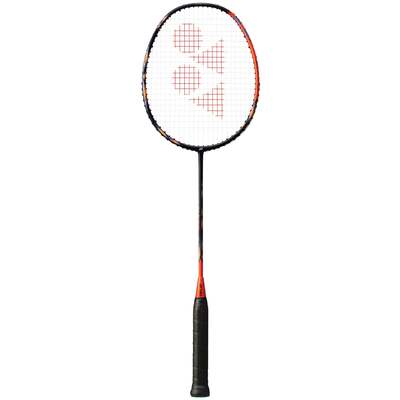
£49.99 at Sweatband · best for beginners and intermediates who like to attack
The Yonex Astrox 77 Play brings several features from Yonex's attacking Astrox range down to a mid-range price. At 83g it falls in the 4U weight class, light enough to move quickly, while the head heavy balance adds momentum for clears and smashes. The shaft is high-flex and, according to the listing, 10mm longer than standard, both of which help players with developing technique get more speed on the shuttle. An isometric head enlarges the sweet spot. It is a good fit for doubles and singles players who want to hit harder without moving to a stiff racket.
✓ Pros
- Light 4U frame with head heavy power
- High-flex shaft suits developing swings
- Isometric head for a larger sweet spot
✕ Cons
- Head heavy balance is a little slower in fast net exchanges
- Strong, experienced hitters may want a stiffer shaft
2. Best budget
Carlton Tru-Storm FS 1000 Badminton Racket
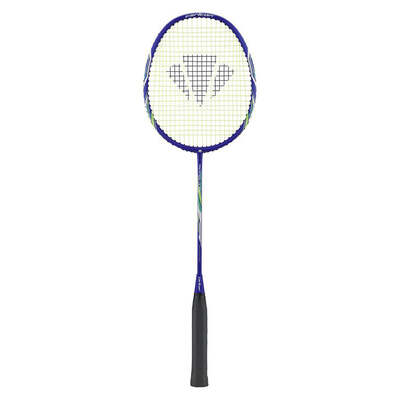
£21.99 at Sweatband · best for casual players and complete beginners
The Carlton Tru-Storm FS 1000 is designed for beginners and comes at a budget price. Its aluminium-graphite construction is heavier than full graphite rackets at 93g, but it is sturdy, which matters for casual play where frames get clashed. The isometric head adds forgiveness on off-centre hits, and it comes strung with a durable nylon string and a half cover. It will not feel as quick as the lighter graphite rackets here, but for school halls, leisure centre sessions and family games it does the job.
✓ Pros
- Budget price
- Durable aluminium-graphite build
- Isometric head and half cover included
✕ Cons
- 93g is heavier and slower than graphite rackets
- Nylon string gives less feel than synthetic badminton strings
3. Best for beginners
Babolat Satelite Rise Badminton Racket
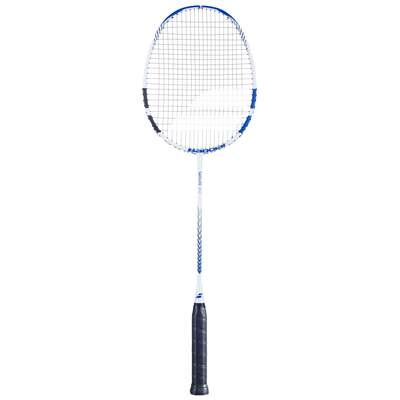
£40.00 at Sweatband · best for newer players who want an easy all-rounder
The Babolat Satelite Rise is aimed at beginners who want all-round performance and accuracy. At 84g it sits in the 4U weight band, and the even balance means it neither pulls towards the head nor feels whippy, which makes it a good neutral racket to learn on. Babolat lists a larger head and its Shot Optimizer technology for forgiveness, and a medium flex shaft. It comes pre-strung with Babolat synthetic string. If you are not yet sure whether you are an attacking or defensive player, an even balance like this is a sensible starting point.
✓ Pros
- Even balance suits every part of the court
- Light 84g graphite frame
- Larger head for forgiveness
✕ Cons
- Medium flex gives less free power than a high-flex shaft
- Less smash power than a head heavy racket
4. Best lightweight
Babolat Satelite Gravity 74 Badminton Racket
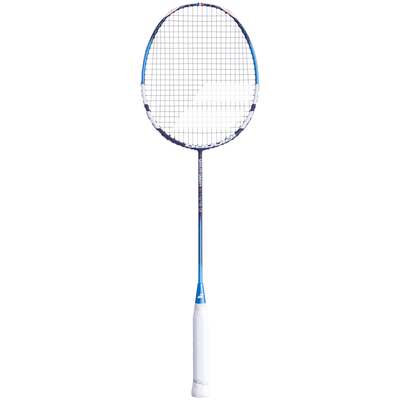
£70.00 at Sweatband · best for defensive doubles players and fast net play
At a listed 74g, the Babolat Satelite Gravity 74 is the lightest racket on our list, well below the 4U band most rackets fall into. Combined with a head light balance, that makes it very fast to react with in drives, net kills and defence, which is why Babolat pitches it at defensive club players. The medium flex shaft keeps it controllable, and it is strung with Babolat iFeel string for shock absorption and comes with a full cover. The trade-off is that very light, head light rackets give less help on clears and smashes from the back court.
✓ Pros
- Extremely light at 74g
- Head light balance for quick reactions
- Full cover included
✕ Cons
- Less power from the back of the court
- Very light frames can feel less stable on hard returns
5. Best for club all-rounders
Carlton Velocitex V300 Badminton Racket
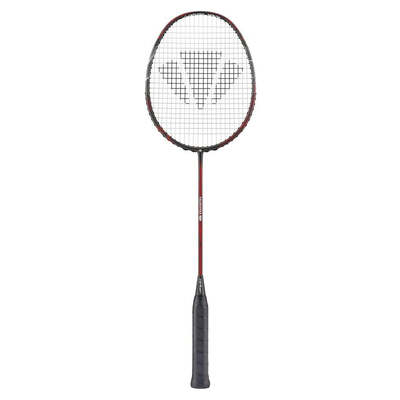
£54.99 at Sweatband · best for regular club players who play both singles and doubles
The Carlton Velocitex V300 is aimed at all-round club players. It pairs an even balance and medium flex with an 84g graphite frame, a neutral combination that works across the whole court. Carlton lists Xtreme Tension Frame technology, which lets the frame take higher string tensions; that matters to improving players who want to restring tighter for more control. It comes pre-strung with a multifilament string and a full-length cover. It sits in the mid-range price band.
✓ Pros
- Balanced, neutral specification
- Frame designed to take higher string tensions
- Multifilament string and full cover included
✕ Cons
- Not specialised for big smashes or very fast defence
- Medium flex needs a reasonably developed swing
6. Best premium
Yonex Astrox 77 Tour Badminton Racket
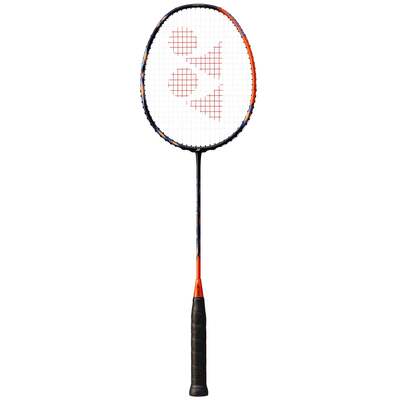
£139.00 at Sweatband · best for committed attacking players ready for a performance racket
The Yonex Astrox 77 Tour is the step up from the Astrox 77 Play for players who already have solid technique. It keeps the 4U (83g) weight, head heavy balance and 10mm longer shaft, but the listing describes it as built for offensive, advanced players, with Nanomesh Neo in the shaft and Light Feel Carbon Neo in the frame. Yonex also lists a super slim shaft and Energy Boost Cap Plus for stability. It sits in the premium price band and makes most sense for regular league or club players who smash a lot.
✓ Pros
- Light 4U frame with a head heavy, attacking balance
- Longer shaft for extra smash leverage
- Higher-grade materials than the Play version
✕ Cons
- Premium price band
- Designed for advanced players, so less forgiving for beginners
Weight classes: what 3U, 4U and 5U mean
Badminton racket weights are often shown as a U number. Each step covers about 5g of unstrung frame weight: 2U is roughly 90 to 94g, 3U is 85 to 89g, 4U is 80 to 84g and 5U is 75 to 79g. Not every brand uses the U system, so you will often just see a weight in grams.
Lighter rackets (4U and 5U) are quicker to move and react with, which helps in doubles and for players still building strength. Heavier rackets (3U and above) feel more stable and carry more momentum into the shuttle, adding power on clears and smashes. For most adult club players, 4U is the sensible middle ground.
Cheaper aluminium or steel rackets often weigh 90g or more. They are durable, but feel slower than graphite rackets.
Balance: head heavy, even or head light
Head heavy rackets have more weight towards the top of the frame. They add momentum for powerful smashes and clears from the back court, which suits attacking singles players and the rear player in doubles.
Head light rackets are faster to manoeuvre, which helps with drives, net play and defending smashes. They suit front-court doubles players and anyone who likes a quick, reactive game. Even balance sits between the two and is a good choice if you play all over the court or are not yet sure of your style.
Shaft flex: flexible, medium or stiff
A flexible shaft bends more during the swing and releases that energy at impact, giving easy power to players with slower or less refined swings. This is why most beginner and improver rackets are described as flexible or high-flex.
Stiff shafts bend less and return faster, giving more precision and control to players who can generate their own racket head speed with good wrist and forearm technique. In the hands of a beginner, a stiff racket often feels harsh and underpowered. Medium flex is a good compromise for intermediate club players.
Head shape, strings and grip
Most modern rackets have an isometric head, which is squarer at the top and widens the sweet spot compared with older oval heads. For anyone short of advanced level, an isometric head is the better choice.
Factory strings on budget rackets are usually durable rather than lively. Once you play regularly, restringing with a dedicated badminton string at a moderate tension improves feel. Higher tensions give more control but shrink the sweet spot and need a stronger, cleaner hit, so beginners should not go too tight.
Grip sizes are often marked G4 or G5 on Yonex rackets, where a higher number means a thinner handle. You can build a handle up with an overgrip or towel grip, so if in doubt choose the thinner option.
FAQs
What badminton racket should a beginner buy?
Look for a light graphite racket, ideally 4U (around 80 to 84g), with a flexible or medium-flex shaft, an isometric head and an even or slightly head heavy balance. This combination is forgiving and makes it easier to get the shuttle to the back of the court.
Is 3U or 4U better?
4U rackets are lighter and quicker to handle, which suits most beginners, doubles players and anyone who wants speed at the net. 3U rackets are heavier and more stable, adding power for strong players who mainly attack from the back. For most club players, 4U is the safer choice.
Should I choose a head heavy or head light badminton racket?
Choose head heavy if you enjoy smashing and play a lot from the back court. Choose head light if you play mostly at the net in doubles or like a fast, defensive game. Even balance suits all-round players and beginners who have not settled on a style.
What does flex mean on a badminton racket?
Flex describes how much the shaft bends during a swing. Flexible shafts give easy power to slower swings, stiff shafts give more control to fast, well-timed swings, and medium flex sits in between. Beginners usually do best with a flexible shaft.
How often should I restring a badminton racket?
A common rule is to restring as many times a year as you play per week, so a twice-a-week player would restring about twice a year. Restring sooner if a string breaks or the string bed starts to feel dead.
Can I use a badminton racket outdoors?
Yes, any racket will work in the garden, but wind makes proper badminton difficult and outdoor play increases the risk of knocks and string damage. Many people keep a cheaper, durable racket for outdoor games and a better graphite one for the sports hall.
Want to see everything? Browse all racket sports or read our other buying guides.
Affiliate disclosure: buychecked may earn commission from qualifying purchases made via links on this page — at no extra cost to you. Prices checked against live merchant feeds.